 Leeds Air Con Experts
When it comes to installing air conditioning in your Leeds home, one of the first decisions you'll face is whether to go for a single split system or a multi-split setup. Both have their advantages, and the right choice depends on your specific needs, property layout, and budget.
In this comprehensive guide, we'll break down the differences between split and multi-split systems, compare their costs and benefits, and help you decide which option is best for your property.
What Is a Single Split System?
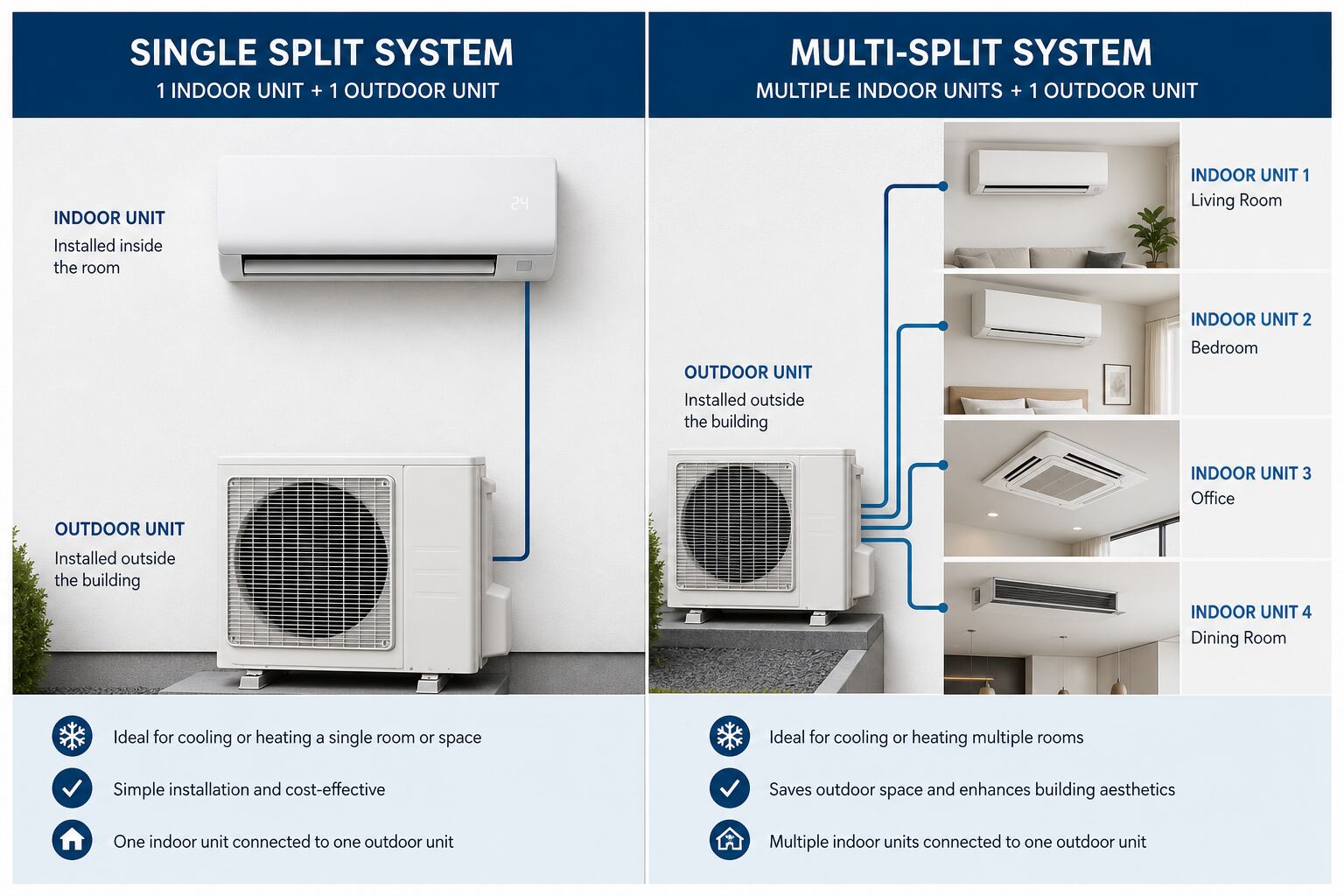
A single split system is the most common type of air conditioning installation. It consists of:
- One indoor unit: Mounted on the wall (or ceiling) inside your home
- One outdoor unit: Installed outside your property
- Refrigerant pipes: Connecting the indoor and outdoor units
The indoor unit cools (or heats) a single room or open-plan area. If you want to cool multiple rooms, you'll need multiple single split systems - each with its own indoor and outdoor unit.
How It Works
The indoor unit absorbs heat from the room and transfers it to the outdoor unit via refrigerant pipes. The outdoor unit then releases the heat outside. In heating mode, the process reverses - the system extracts heat from outside air and brings it indoors.
What Is a Multi-Split System?
A multi-split system allows you to connect multiple indoor units to a single outdoor unit. This means you can cool or heat several rooms using just one outdoor compressor.
Typical configurations include:
- 2-1 system: Two indoor units, one outdoor unit
- 3-1 system: Three indoor units, one outdoor unit
- 4-1 system: Four indoor units, one outdoor unit
- 5-1 system: Five indoor units, one outdoor unit (maximum for most residential systems)
How It Works
The outdoor unit contains a more powerful compressor that can handle multiple indoor units. Each indoor unit can be controlled independently, so you can set different temperatures in different rooms. The system uses advanced refrigerant distribution to ensure each room gets the cooling or heating it needs.
Split vs Multi-Split: Head-to-Head Comparison
| Feature | Single Split | Multi-Split |
|---|---|---|
| Number of outdoor units | One per indoor unit | One for all indoor units |
| Rooms cooled | One room per system | Multiple rooms (2-5) |
| Installation cost | Lower per unit | Higher upfront, but cheaper per room |
| Outdoor space required | More space needed for multiple units | Less space - only one outdoor unit |
| Independent control | Yes, each room independent | Yes, each room independent |
| Energy efficiency | Good | Excellent (inverter technology) |
| Noise levels | Multiple outdoor units = more noise | One outdoor unit = less noise |
| Aesthetics | Multiple outdoor units visible | Cleaner look - one outdoor unit |
| Flexibility | Easy to add more units later | Limited by outdoor unit capacity |
| Maintenance | Each unit maintained separately | One outdoor unit to maintain |
Pros and Cons of Single Split Systems
Advantages
- Lower initial cost per unit
- Simple installation
- Easy to add more units later
- Each system operates independently
- Ideal for single rooms or small properties
- Widely available, many installer options
Disadvantages
- Multiple outdoor units needed for multiple rooms
- More outdoor space required
- Higher total cost if cooling 3+ rooms
- More outdoor noise (multiple compressors)
- Less aesthetically pleasing exterior
- More maintenance (multiple outdoor units)
Pros and Cons of Multi-Split Systems
Advantages
- Only one outdoor unit needed
- Less outdoor space required
- More cost-effective for 3+ rooms
- Quieter (one outdoor unit)
- Cleaner exterior appearance
- More energy efficient (inverter technology)
- Easier maintenance (one outdoor unit)
Disadvantages
- Higher upfront cost
- More complex installation
- Limited by outdoor unit capacity
- Harder to add more rooms later
- If outdoor unit fails, all rooms affected
- Fewer installer options (specialist knowledge required)
Cost Comparison: Split vs Multi-Split
Let's look at the real costs for a typical Leeds home:
Scenario: Cooling 3 Bedrooms
| Option | Cost (inc. installation) | Outdoor Units |
|---|---|---|
| 3 x Single Split Systems | £4,500 - £6,000 | 3 outdoor units |
| 1 x 3-1 Multi-Split System | £3,800 - £5,200 | 1 outdoor unit |
Verdict: For 3 rooms, a multi-split system is typically £700-£800 cheaper and requires only one outdoor unit.
Scenario: Cooling 2 Rooms
| Option | Cost (inc. installation) | Outdoor Units |
|---|---|---|
| 2 x Single Split Systems | £3,000 - £4,000 | 2 outdoor units |
| 1 x 2-1 Multi-Split System | £2,800 - £3,800 | 1 outdoor unit |
Verdict: For 2 rooms, the cost is similar, but a multi-split system saves outdoor space and looks cleaner.
Scenario: Cooling 1 Room
| Option | Cost (inc. installation) |
|---|---|
| 1 x Single Split System | £1,500 - £2,500 |
| Multi-Split (not applicable) | Not cost-effective for single room |
Verdict: For a single room, a single split system is the obvious choice.
Which System Should You Choose?
Choose a Single Split System If:
- You only need to cool one room
- You have plenty of outdoor space for multiple units
- You want to start with one room and add more later
- You're on a tight budget and want the lowest upfront cost
- You live in a flat with limited outdoor space for one unit only
Choose a Multi-Split System If:
- You need to cool 2 or more rooms
- You have limited outdoor space
- You want a cleaner exterior appearance
- You want better energy efficiency
- You prefer less outdoor noise
- You're cooling 3+ rooms (more cost-effective)
Technical Considerations
Outdoor Space Requirements
Single Split: Each outdoor unit needs approximately 1m² of space with good airflow. If you're cooling 3 rooms with single split systems, you'll need space for 3 outdoor units.
Multi-Split: You only need space for one outdoor unit, regardless of how many indoor units you have. The outdoor unit is larger than a single split outdoor unit, but still only requires about 1.5m² of space.
Pipe Run Distance
Single Split: The distance between indoor and outdoor units is typically limited to 15-20 metres. Beyond this, efficiency drops significantly.
Multi-Split: The outdoor unit can typically handle pipe runs of up to 50-70 metres total, distributed across all indoor units. This gives you more flexibility in positioning indoor units.
Electrical Requirements
Single Split: Each unit typically requires a dedicated 13A socket or fused spur. Multiple units may require electrical upgrades.
Multi-Split: The outdoor unit requires a dedicated circuit, typically 16-32A depending on system size. This may require an electrical upgrade, but it's only one circuit regardless of how many indoor units you have.
Energy Efficiency
Single Split: Modern single split systems have SEER (Seasonal Energy Efficiency Ratio) ratings of 6.0-8.5, which is very efficient.
Multi-Split: Multi-split systems typically have SEER ratings of 7.0-9.0, making them slightly more efficient. This is because the inverter compressor can modulate its speed more precisely to match the total demand.
Installation Considerations
Installation Time
Single Split: A typical single split installation takes 4-6 hours. If you're installing 3 single split systems, that's 12-18 hours of work, typically spread over 2 days.
Multi-Split: A 3-1 multi-split installation typically takes 8-12 hours, usually completed in one day. This is because the installers only need to set up one outdoor unit and run pipes to multiple indoor units.
Disruption
Single Split: Each installation causes some disruption (drilling, pipe routing, etc.). Multiple installations mean multiple days of disruption.
Multi-Split: All the disruption happens in one go. It's more intensive on the day, but you only have one day of disruption instead of multiple days.
Aesthetics
Single Split: Multiple outdoor units on your exterior wall can look cluttered, especially if you're cooling 3+ rooms.
Multi-Split: One outdoor unit looks much cleaner and is less obtrusive. This is particularly important if your property is visible from the street.
Long-Term Considerations
Maintenance
Single Split: Each outdoor unit needs to be serviced annually. If you have 3 outdoor units, that's 3 services to arrange and pay for.
Multi-Split: You only have one outdoor unit to service, making maintenance simpler and potentially cheaper.
Repairs
Single Split: If one outdoor unit fails, only one room is affected. The other rooms continue to work normally.
Multi-Split: If the outdoor unit fails, all rooms are affected. However, outdoor units are generally very reliable, and most issues can be fixed quickly.
Future Expansion
Single Split: Very easy to add more rooms later. Just install another single split system.
Multi-Split: More difficult to expand. You need to ensure your outdoor unit has enough capacity for additional indoor units. If it doesn't, you'll need to replace the outdoor unit or install a separate system.
Our Recommendation for Leeds Homes
Based on our experience installing air conditioning in Leeds properties, here's what we typically recommend:
- For 1 room: Single split system - simple, cost-effective, and easy to install
- For 2 rooms: Either option works well. Choose multi-split if outdoor space is limited or you want a cleaner look
- For 3+ rooms: Multi-split system - more cost-effective, cleaner appearance, and better energy efficiency
Of course, every property is different. The best way to know which system is right for your home is to get a professional survey. Our F-Gas certified engineers will assess your property, discuss your needs, and recommend the best solution.
Not Sure Which System Is Right for You?
Get a free, no-obligation survey from our F-Gas certified engineers. We'll assess your property, discuss your needs, and recommend the best air conditioning solution for your Leeds home.
Request Your Free Survey →Frequently Asked Questions
Can I mix single split and multi-split systems?
Yes, you can have a multi-split system for most of your home and add a single split system for an additional room. This gives you flexibility if your multi-split outdoor unit is at full capacity.
Which system is quieter?
Multi-split systems are generally quieter because you only have one outdoor unit running instead of multiple units. The indoor units for both systems are equally quiet (typically 19-25 decibels).
Can I control each room independently with a multi-split system?
Yes, each indoor unit in a multi-split system has its own remote control and can be set to a different temperature. You can even turn off units in rooms you're not using.
What happens if the outdoor unit in a multi-split system fails?
If the outdoor unit fails, all connected indoor units will stop working. However, outdoor units are very reliable, and most issues can be fixed quickly. We offer comprehensive warranties and rapid response times for repairs.
Can I add more indoor units to a multi-split system later?
It depends on the capacity of your outdoor unit. Most multi-split outdoor units can handle 2-5 indoor units. If your outdoor unit has spare capacity, you can add more indoor units. If not, you'll need to replace the outdoor unit or install a separate system.
Which system is more energy efficient?
Multi-split systems are typically slightly more efficient due to advanced inverter technology that can modulate compressor speed more precisely. However, the difference is small - both systems are very efficient compared to traditional heating and cooling methods.
How much does a multi-split system cost compared to single split systems?
For 1-2 rooms, the cost is similar. For 3+ rooms, a multi-split system is typically 15-20% cheaper than installing multiple single split systems.
Conclusion
Both single split and multi-split air conditioning systems have their place. The right choice depends on your specific needs, property layout, and budget.
For single rooms or properties with plenty of outdoor space, single split systems are a great choice. For multiple rooms, limited outdoor space, or when you want a cleaner exterior appearance, multi-split systems are the way to go.
The best way to know which system is right for your Leeds home is to get a professional survey. Our F-Gas certified engineers will assess your property, discuss your needs, and recommend the best solution - with a fixed-price quote and no obligation.
Modern air conditioning systems are highly efficient and can provide year-round comfort. Get in touch today to discuss your options and get a free, no-obligation quote.